
How to Get Court Records
Start with the Online Court Records System for Wilson County court records. It is the fastest route. The public search reaches Circuit Criminal, Circuit Civil, General Sessions, and General Sessions Division 3. Treat what you get as a finding aid rather than the clerk's official record. Before you ask for a file, copy down the details. Get the exact court, case number, filing date, and document name. A search that fails is not proof the record is missing. The same goes for a web challenge that blocks you. Call the office that holds it or go to its counter instead.
The Circuit Court Clerk takes document requests over the web. Staff will explain costs by phone or in person. Mail copies can be arranged with the custodian as well. Chancery and Probate files sit with the Clerk and Master. Older material belongs to the county archives. For county administrative records, the formal Tennessee Public Records Act request channel is another option. Note that electronic filing is a service for lawyers. It is not a public library of court documents.
- Search the case and record its exact court and docket number.
- Name the paper, date, and whether a plain or certified copy is needed.
- Use the Wilson Court Document Request, call, visit, or arrange a mailed request.
- Ask the holding office to confirm the current copy, certification, delivery, and archive charges.
- Check the delivered record against the case number and requested filing.
Wilson Document Request Fields
The Wilson County form targets one specific paper, not a broad research question. It asks for a first and last name, email address, and phone number. It also wants your court choice, document date, docket number, and document type. The court menu lists Circuit Civil, General Sessions III, and Juvenile Child Support. General Sessions I and II are there too, along with Circuit Criminal. Comments are optional.
The form shows no fee, identity rule, delivery choice, or processing estimate. Submitting it just opens the exchange. A clerk then identifies the item and sends cost or delivery instructions. Describe the filing as precisely as the docket allows. A vague request slows that step.
| Form field | Useful entry |
|---|---|
| Court | The division named in the case result |
| Document date | The filing or order date shown in the docket |
| Docket number | The complete clerk identifier |
| Document type | Motion, order, judgment, petition, or other named filing |
The official Wilson document request source shows the form's court and document fields.
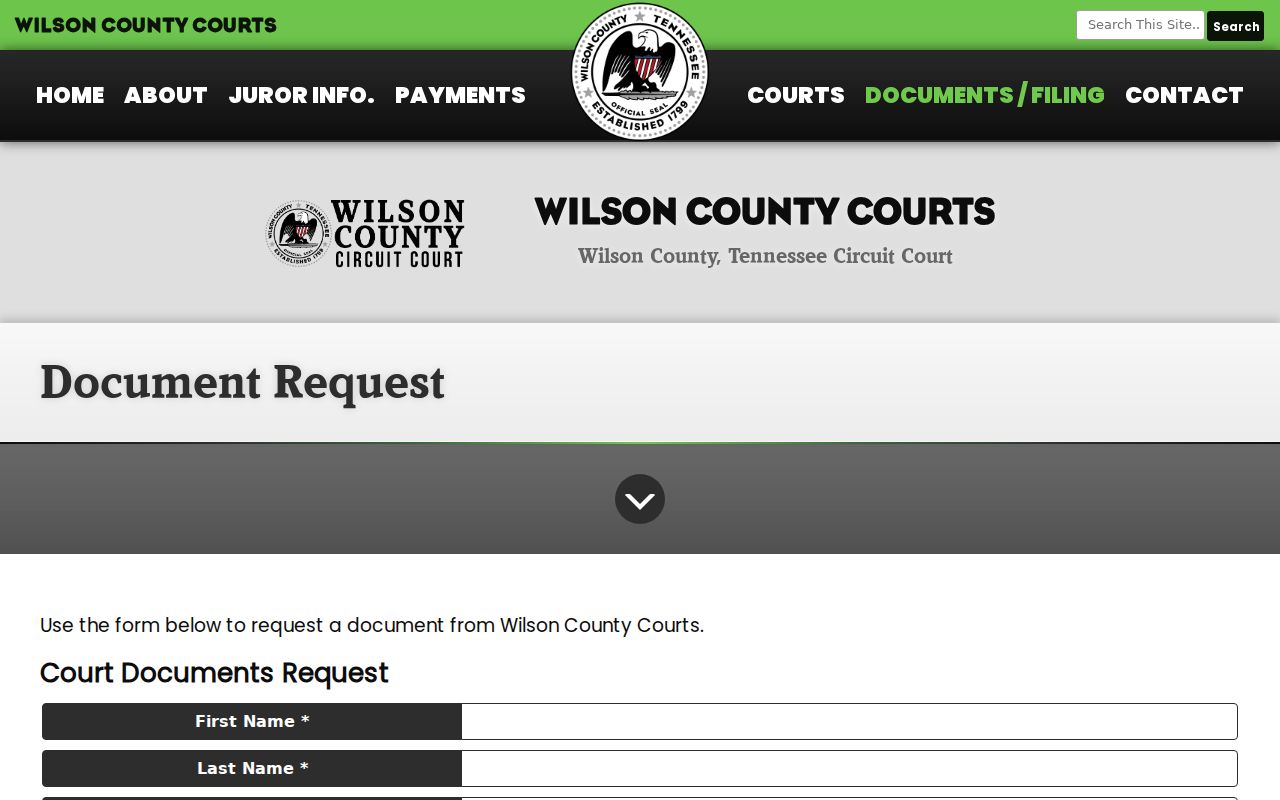
The form view confirms the core of a Wilson County request: a precise docket number paired with the right document type gets you there fastest.
Types of Court Records
Different offices hold different Wilson County court records. The Circuit Court Clerk keeps Circuit, General Sessions, family, juvenile, and related files within its stated duties. Chancery and Probate records belong to the Clerk and Master. City matters stay with each municipal court. A federal filing goes through PACER or the Middle District of Tennessee system. It does not go through a Wilson County clerk.
- Docket sheets and chronological case-event lists
- Complaints, petitions, answers, motions, and returns
- Signed orders, judgments, and recorded dispositions
- Public portions of civil, criminal, family, and juvenile files
- Chancery, Probate, historic, and municipal court records held outside TNCRTINFO
Three Wilson Record Products
A docket, a filed document, and a certified copy each answer a different question. The docket is the index. It shows that an event occurred. A date, setting, or result may appear too. Behind that line sits the actual motion, order, pleading, exhibit, or judgment. A certified copy is simply a clerk-authenticated version of one of those papers.
| Product | What it supplies | Best route |
|---|---|---|
| Docket or case events | Chronology, settings, and status clues | TNCRTINFO or the holding clerk |
| Filed document | The text and content behind an entry | Wilson document request or clerk counter |
| Certified copy | Clerk authentication | Ask the holding clerk expressly for certification |
Printing a page from a browser does not make it certified. Ask which product you truly need before paying for copies.
What a Court Record Contains
Contents vary with the case and its access rules. Wilson County's posted civil docket material shows a court and session header, case number, case style, filing date, attorney fields, last activity, and hearing notes. The full file may hold the papers those events name. The posted Docket Call is only a setting extract. Do not read it as every filing in the case.
| Case number | The court's identifier; TNCRTINFO may search the last numeric segment, such as 12345. |
|---|---|
| Pleadings | Petitions, complaints, answers, motions, and responses filed with the clerk. |
| Orders and judgments | Signed rulings and formal outcomes entered by the court. |
| Docket sheet | A chronological index of filings, settings, and court action. |
| Hearing information | Date, time, judge, last activity, and notes when publicly shown. |
Wilson Archives Holds Old Cases
Current Wilson County court records only reach back so far. Wilson County Archives holds long runs of minute books, case files, wills, deeds, marriages, and microfilm. It was established in 1995. It has sat at 111 S College Street since 1998. Its collections include county loose records beginning in 1799. Circuit material begins in 1810, and Chancery files begin in 1812. When a docket search runs dry, the archive is the better route for genealogy and historic case work. Collection end dates vary by series. The archive lists Circuit minute books through 1982, Chancery case files through 1965, and county court minutes through 1964. Give staff names, an approximate year, the court, and the record type. Note that archive research charges sit apart from a current clerk's copy schedule. Check the Wilson County Archives collection information before requesting an older court record.
Certified Copies and Fees
Plain copies run 50 cents per page on most Wilson County fee pages. Certification often runs $5 plus 50 cents per page. Wording differs by division. General Sessions states a $5 first certified page, then 50 cents for each added page. Some court pages also list fax and archive retrieval charges. Confirm the current total with the office that holds the record. The Circuit Civil fee page shows copy, certification, and archive lines in their official context.
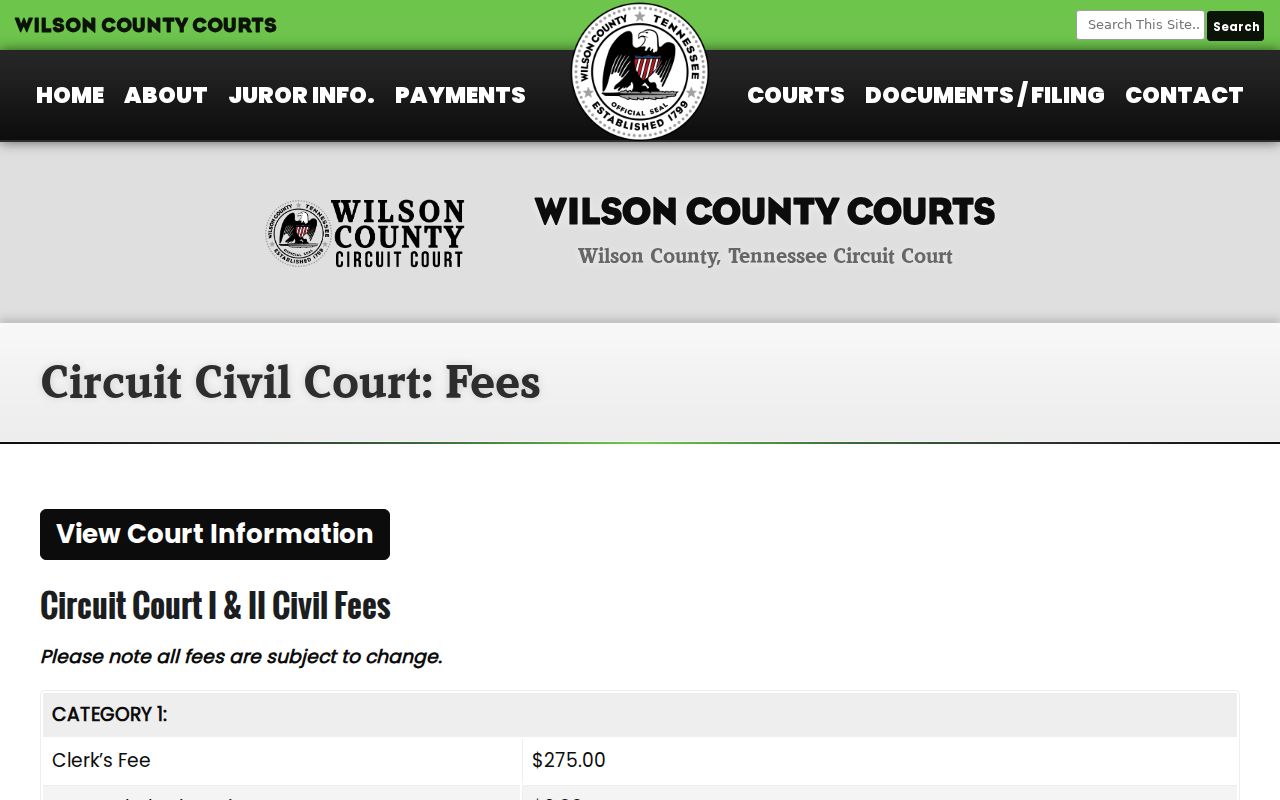
One court's fee list does not govern every Wilson County file. That is reason enough to confirm the division before ordering.
| Item | Amount |
|---|---|
| Plain court copy | $0.50 per page on Wilson court fee pages |
| Certification | Commonly $5 plus $0.50 per page |
| Fax copy on listed division pages | $5 plus $1 per page |
| Standard archive retrieval requested by noon | $11.25 for listed next-day service |
Wilson County Circuit Court Clerk
115 E High Street
Lebanon, TN 37087
615-444-2045
Chancery and Probate Custodian
Chancery and Probate files sit outside the four court options you can see in TNCRTINFO. In Wilson County, both sets of court records live with Clerk and Master Millie Sloan. Walk into Room 200 at 134 S College for Chancery, or call 615-444-2835. Probate works out of Room 201, at 615-466-5311. Mail for either office goes to P.O. Box 1557, Lebanon, TN 37087-1557.
The Clerk and Master keeps the Chancery court docket. The office also issues process, computes and collects court costs, gathers delinquent back taxes, and handles Probate filings. Begin there rather than hunting the Circuit Clerk portal in vain. A Lebanon address alone tells you nothing. The court named on the paperwork decides who holds the file.
Published contact details are on the Wilson County Clerk and Master page.
TPRA or Court Copy Request
A TPRA request and a court-copy request overlap, but they are not the same thing. Want a filed case paper or a certified judgment? Ask the court clerk. The county's formal public-records route fits county records that lack an easy court channel. It also works when you want inspection and copying tracked. That policy demands proof of Tennessee citizenship and treats inspection differently from duplication.
The fee schedule is specific. Black-and-white letter or legal copies run 15 cents per page. Color runs 50 cents per page. Duplication under five pages is free. Labor kicks in after two hours. Vendor cost can pass through, and estimates or prepayment may be required above $50. When a office cannot produce right away, it has seven business days to produce, deny with a basis, or claim added time. Per the Wilson County public-records policy, staff never have to build a new record or compile an answer for you.
One caution for Wilson County requesters: put the Wilson County court name on every submission. Circuit records, Chancery records, and Probate records are separate. Each sits behind its own counter. A Wilson County archive request runs on its own collection and research schedule. Name the custodian, the date range, and the exact record. Then staff can tell a court copy from a county administrative record.
Public Access and Sealed Records
Most Wilson County court records are open. Statute, court rule, a sealing order, or private-data protection can close the door. Some case types drop out or shrink. Juvenile, adoption, dependency, protected family, sealed, and expunged matters may be missing, trimmed to a case shell, or redacted. So a blank TNCRTINFO result does not end the search. The case might sit in Chancery, Probate, Juvenile, a city court, an archive, or an appellate court instead.
Ask the holding clerk which public parts can be released. A redacted page is not proof the full filing never existed. Sealing a civil record takes a serious and substantial interest under Tennessee Rule 1A. No less restrictive means can do the job. Rule 114 covers juvenile and family confidentiality separately.
Key Rules:
Tennessee Supreme Court Rule 34 generally opens court records unless valid authority restricts access.
Tennessee Rule 1A sets the test for sealing civil court records.
Tennessee Rule 114 governs confidentiality in juvenile and family proceedings.